How nutrient starvation impacts the gut microbiome
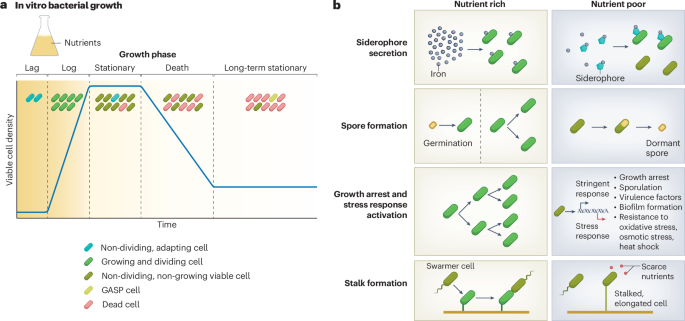
Kjelleberg, S. Starvation in Bacteria (Springer, 1993).
Finkel, S. E. Long-term survival during stationary phase: evolution and the GASP phenotype. Nat. Rev. Microbiol. 4, 113–120 (2006).
Google Scholar
Bernhardt, J., Weibezahn, J., Scharf, C. & Hecker, M. Bacillus subtilis during feast and famine: visualization of the overall regulation of protein synthesis during glucose starvation by proteome analysis. Genome Res. 13, 224–237 (2003).
Google Scholar
Schofield, W. B., Zimmermann-Kogadeeva, M., Zimmermann, M., Barry, N. A. & Goodman, A. L. The stringent response determines the ability of a commensal bacterium to survive starvation and to persist in the gut. Cell Host Microbe 24, 120–132 (2018).
Google Scholar
Townsend, G. E. et al. A master regulator of Bacteroides thetaiotaomicron gut colonization controls carbohydrate utilization and an alternative protein synthesis factor. mBio (2020).
Ontai-Brenning, A., Hamchand, R., Crawford, J. M. & Goodman, A. L. Gut microbes modulate (p)ppGpp during a time-restricted feeding regimen. mBio 14, e0190723 (2023).
Google Scholar
Groisman, E. A., Han, W. & Krypotou, E. Advancing the fitness of gut commensal bacteria. Science 382, 766–768 (2023).
Google Scholar
Han, W. et al. Gut colonization by Bacteroides requires translation by an EF-G paralog lacking GTPase activity. EMBO J. 42, e112372 (2023).
Google Scholar
Liu, B. et al. Starvation responses impact interaction dynamics of human gut bacteria Bacteroides thetaiotaomicron and Roseburia intestinalis. ISME J. 17, 1940–1952 (2023).
Google Scholar
Watson, S. P., Clements, M. O. & Foster, S. J. Characterization of the starvation-survival response of Staphylococcus aureus. J. Bacteriol. 180, 1750–1758 (1998).
Google Scholar
Berney, M. & Cook, G. M. Unique flexibility in energy metabolism allows mycobacteria to combat starvation and hypoxia. PLoS ONE 5, e8614 (2010).
Google Scholar
Zeng, X. et al. Gut bacterial nutrient preferences quantified in vivo. Cell 185, 3441–3456 (2022).
Google Scholar
Zarrinpar, A., Chaix, A., Yooseph, S. & Panda, S. Diet and feeding pattern affect the diurnal dynamics of the gut microbiome. Cell Metab. 20, 1006–1017 (2014).
Google Scholar
David, L. A. et al. Diet rapidly and reproducibly alters the human gut microbiome. Nature 505, 559–563 (2014).
Google Scholar
Koropatkin, N. M., Cameron, E. A. & Martens, E. C. How glycan metabolism shapes the human gut microbiota. Nat. Rev. Microbiol. 10, 323–335 (2012).
Google Scholar
Monod, J. The growth of bacterial cultures. Annu. Rev. Microbiol. (1949).
Dworkin, J. & Harwood, C. S. Metabolic reprogramming and longevity in quiescence. Annu. Rev. Microbiol. 76, 91–111 (2022).
Google Scholar
Kramer, J., Özkaya, Ö & Kümmerli, R. Bacterial siderophores in community and host interactions. Nat. Rev. Microbiol. 18, 152–163 (2020).
Google Scholar
Lennon, J. T. & Jones, S. E. Microbial seed banks: the ecological and evolutionary implications of dormancy. Nat. Rev. Microbiol. 9, 119–130 (2011).
Google Scholar
Avrani, S., Katz, S. & Hershberg, R. Adaptations accumulated under prolonged resource exhaustion are highly transient. mSphere (2020).
Shoemaker, W. R. et al. Microbial population dynamics and evolutionary outcomes under extreme energy limitation. Proc. Natl Acad. Sci. USA 118, e2101691118 (2021).
Google Scholar
Katz, S. et al. Dynamics of adaptation during three years of evolution under long-term stationary phase. Mol. Biol. Evol.38, 2778–2790 (2021).
Google Scholar
Ratib, N. R., Seidl, F., Ehrenreich, I. M. & Finkel, S. E. Evolution in long-term stationary-phase batch culture: emergence of divergent Escherichia coli lineages over 1,200 days. mBio (2021).
Boutte, C. C. & Crosson, S. Bacterial lifestyle shapes stringent response activation. Trends Microbiol. 21, 174–180 (2013).
Google Scholar
Irving, S. E., Choudhury, N. R. & Corrigan, R. M. The stringent response and physiological roles of (pp)pGpp in bacteria. Nat. Rev. Microbiol. 19, 256–271 (2021).
Google Scholar
Battesti, A., Majdalani, N. & Gottesman, S. The RpoS-mediated general stress response in Escherichia coli. Annu. Rev. Microbiol. 65, 189–213 (2011).
Google Scholar
Boutte, C. C. & Crosson, S. The complex logic of stringent response regulation in Caulobacter crescentus: starvation signalling in an oligotrophic environment. Mol. Microbiol. 80, 695–714 (2011).
Google Scholar
Hallgren, J., et al. Phosphate starvation decouples cell differentiation from DNA replication control in the dimorphic bacterium Caulobacter crescentus. PLoS Genet. 19, e1010882 (2023).
Google Scholar
Krypotou, E. et al. Bacteria require phase separation for fitness in the mammalian gut. Science 379, 1149–1156 (2023).
Google Scholar
Browne, H. P., et al. Host adaptation in gut Firmicutes is associated with sporulation loss and altered transmission cycle. Genome Biol. 22, 204 (2021).
Google Scholar
Egan, M., Dempsey, E., Ryan, C. A., Ross, R. P. & Stanton, C. The sporobiota of the human gut. Gut Microbes 13, 1863134 (2021).
Google Scholar
Lawley, T. D. et al. Antibiotic treatment of Clostridium difficile carrier mice triggers a supershedder state, spore-mediated transmission, and severe disease in immunocompromised hosts. Infect. Immun. 77, 3661–3669 (2009).
Google Scholar
Browne, H. P. et al. Culturing of ‘unculturable’ human microbiota reveals novel taxa and extensive sporulation. Nature 533, 543–546 (2016).
Google Scholar
Cesar, S., Willis, L. & Huang, K. C. Bacterial respiration during stationary phase induces intracellular damage that leads to delayed regrowth. iScience 25, 103765 (2022).
Google Scholar
Şimşek, E. & Kim, M. Power-law tail in lag time distribution underlies bacterial persistence. Proc. Natl Acad. Sci. USA 116, 17635–17640 (2019).
Google Scholar
Kaplan, Y. et al. Observation of universal ageing dynamics in antibiotic persistence. Nature 600, 290–294 (2021).
Google Scholar
Moreno-Gámez, S. et al. Wide lag time distributions break a trade-off between reproduction and survival in bacteria. Proc. Natl Acad. Sci. USA 117, 18729–18736 (2020).
Google Scholar
Schink, S. J. et al. MetA is a “thermal fuse” that inhibits growth and protects Escherichia coli at elevated temperatures. Cell Rep. 40, 111290 (2022).
Google Scholar
Brauer, A. M., Shi, H., Levin, P. A. & Huang, K. C. Physiological and regulatory convergence between osmotic and nutrient stress responses in microbes. Curr. Opin. Cell Biol. 81, 102170 (2023).
Google Scholar
Zimmerman, C. A. et al. A gut-to-brain signal of fluid osmolarity controls thirst satiation. Nature 568, 98–102 (2019).
Google Scholar
Tagkopoulos, I., Liu, Y.-C. & Tavazoie, S. Predictive behavior within microbial genetic networks. Science 320, 1313–1317 (2008).
Google Scholar
Schwartz, D. A., Shoemaker, W. R., Măgălie, A., Weitz, J. S. & Lennon, J. T. Bacteria–phage coevolution with a seed bank. ISME J. 17, 1315–1325 (2023).
Google Scholar
Murdoch, C. C. & Skaar, E. P. Nutritional immunity: the battle for nutrient metals at the host–pathogen interface. Nat. Rev. Microbiol. 20, 657–670 (2022).
Google Scholar
Liang, Q. et al. Sialic acid plays a pivotal role in licensing Citrobacter rodentium’s transition from the intestinal lumen to a mucosal adherent niche. Proc. Natl Acad. Sci. USA 120, e2301115120 (2023).
Google Scholar
Pal, R. R. et al. Pathogenic E. coli extracts nutrients from infected host cells utilizing injectisome components. Cell 177, 683–696 (2019).
Google Scholar
van der Meer-Janssen, Y. P., van Galen, J., Batenburg, J. J. & Helms, J. B. Lipids in host–pathogen interactions: pathogens exploit the complexity of the host cell lipidome. Prog. Lipid Res. 49, 1–26 (2010).
Google Scholar
Kuhn, H. W., et al. BB0562 is a nutritional virulence determinant with lipase activity important for Borrelia burgdorferi infection and survival in fatty acid deficient environments. PLoS Pathog. 17, e1009869 (2021).
Google Scholar
Abu Kwaik, Y. & Bumann, D. Microbial quest for food in vivo: ‘nutritional virulence’ as an emerging paradigm. Cell. Microbiol. 15, 882–890 (2013).
Google Scholar
Kaiser, J. C. & Heinrichs, D. E. Branching out: alterations in bacterial physiology and virulence due to branched-chain amino acid deprivation. mBio (2018).
Caballero-Flores, G., Pickard, J. M. & Núñez, G. Microbiota-mediated colonization resistance: mechanisms and regulation. Nat. Rev. Microbiol. 21, 347–360 (2023).
Google Scholar
Aranda-Díaz, A. et al. Establishment and characterization of stable, diverse, fecal-derived in vitro microbial communities that model the intestinal microbiota. Cell Host Microbe 30, 260–272 (2022).
Google Scholar
Spragge, F. et al. Microbiome diversity protects against pathogens by nutrient blocking. Science 382, eadj3502 (2023).
Google Scholar
Ho, P.-Y., Nguyen, T. H., Sanchez, J. M., DeFelice, B. C. & Huang, K. C. Resource competition predicts assembly of gut bacterial communities in vitro. Nat. Microbiol. 9, 1036–1048 (2024).
Google Scholar
Hammarlund, S. P., Chacón, J. M. & Harcombe, W. R. A shared limiting resource leads to competitive exclusion in a cross-feeding system. Environ. Microbiol. 21, 759–771 (2019).
Google Scholar
Olsen, L., Thum, E. & Rohner, N. Lipid metabolism in adaptation to extreme nutritional challenges. Dev. Cell 56, 1417–1429 (2021).
Google Scholar
Carey, H. V., Walters, W. A. & Knight, R. Seasonal restructuring of the ground squirrel gut microbiota over the annual hibernation cycle. Am. J. Physiol. Regul. Integr. Comp. Physiol. 304, R33–R42 (2013).
Google Scholar
Dill-McFarland, K. A. et al. Hibernation alters the diversity and composition of mucosa-associated bacteria while enhancing antimicrobial defence in the gut of 13-lined ground squirrels. Mol. Ecol. 23, 4658–4669 (2014).
Google Scholar
Sonoyama, K. et al. Response of gut microbiota to fasting and hibernation in Syrian hamsters. Appl. Environ. Microbiol. 75, 6451–6456 (2009).
Google Scholar
Sommer, F. et al. The gut microbiota modulates energy metabolism in the hibernating brown bear Ursus arctos. Cell Rep. 14, 1655–1661 (2016).
Google Scholar
Ho, P.-Y., Good, B. H. & Huang, K. C. Competition for fluctuating resources reproduces statistics of species abundance over time across wide-ranging microbiotas. eLife 11, e75168 (2022).
Google Scholar
Costello, E. K., Gordon, J. I., Secor, S. M. & Knight, R. Postprandial remodeling of the gut microbiota in Burmese pythons. ISME J. 4, 1375–1385 (2010).
Google Scholar
Di Francesco, A., Di Germanio, C., Bernier, M. & De Cabo, R. A time to fast. Science 362, 770–775 (2018).
Google Scholar
Maifeld, A. et al. Fasting alters the gut microbiome reducing blood pressure and body weight in metabolic syndrome patients. Nat. Commun. 12, 1970 (2021).
Google Scholar
Mesnage, R., Grundler, F., Schwiertz, A., Le Maho, Y. & de Toledo, F. W. Changes in human gut microbiota composition are linked to the energy metabolic switch during 10 d of Buchinger fasting. J. Nutr. Sci. 8, e36 (2019).
Google Scholar
Paukkonen, I., Törrönen, E.-N., Lok, J., Schwab, U. & El-Nezami, H. The impact of intermittent fasting on gut microbiota: a systematic review of human studies. Front. Nutr. 11, 1342787 (2024).
Google Scholar
Li, G. et al. Intermittent fasting promotes white adipose browning and decreases obesity by shaping the gut microbiota. Cell Metab. 26, 672–685 (2017).
Google Scholar
von Schwartzenberg, R. J. et al. Caloric restriction disrupts the microbiota and colonization resistance. Nature 595, 272–277 (2021).
Google Scholar
Depommier, C. et al. Supplementation with Akkermansia muciniphila in overweight and obese human volunteers: a proof-of-concept exploratory study. Nat. Med. 25, 1096–1103 (2019).
Google Scholar
Sonnenburg, J. L. et al. Glycan foraging in vivo by an intestine-adapted bacterial symbiont. Science 307, 1955–1959 (2005).
Google Scholar
Kohl, K. D., Amaya, J., Passement, C. A., Dearing, M. D. & McCue, M. D. Unique and shared responses of the gut microbiota to prolonged fasting: a comparative study across five classes of vertebrate hosts. FEMS Microbiol. Ecol. 90, 883–894 (2014).
Google Scholar
Leeming, E. R., Johnson, A. J., Spector, T. D. & Le Roy, C. I. Effect of diet on the gut microbiota: rethinking intervention duration. Nutrients 11, 2862 (2019).
Google Scholar
Smits, S. A. et al. Seasonal cycling in the gut microbiome of the Hadza hunter–gatherers of Tanzania. Science 357, 802–806 (2017).
Google Scholar
Desai, M. S. et al. A dietary fiber-deprived gut microbiota degrades the colonic mucus barrier and enhances pathogen susceptibility. Cell 167, 1339–1353 (2016).
Google Scholar
Sonnenburg, E. D. et al. Diet-induced extinctions in the gut microbiota compound over generations. Nature 529, 212–215 (2016).
Google Scholar
Shin, N.-R., Whon, T. W. & Bae, J.-W. Proteobacteria: microbial signature of dysbiosis in gut microbiota. Trends Biotechnol. 33, 496–503 (2015).
Google Scholar
Fusco, W. et al. Short-chain fatty-acid-producing bacteria: key components of the human gut microbiota. Nutrients 15, 2211 (2023).
Google Scholar
Sonnenburg, E. D. & Sonnenburg, J. L. Starving our microbial self: the deleterious consequences of a diet deficient in microbiota-accessible carbohydrates. Cell Metab. 20, 779–786 (2014).
Google Scholar
Windey, K., De Preter, V. & Verbeke, K. Relevance of protein fermentation to gut health. Mol. Nutr. Food Res. 56, 184–196 (2012).
Google Scholar
Atkinson, C., Frankenfeld, C. L. & Lampe, J. W. Gut bacterial metabolism of the soy isoflavone daidzein: exploring the relevance to human health. Exp. Biol. Med. 230, 155–170 (2005).
Google Scholar
Beam, A., Clinger, E. & Hao, L. Effect of diet and dietary components on the composition of the gut microbiota. Nutrients 13, 2795 (2021).
Google Scholar
Martin-Gallausiaux, C., Marinelli, L., Blottière, H. M., Larraufie, P. & Lapaque, N. SCFA: mechanisms and functional importance in the gut. Proc. Nutr. Soc. 80, 37–49 (2021).
Google Scholar
Armstrong, H. K. et al. Unfermented β-fructan fibers fuel inflammation in select inflammatory bowel disease patients. Gastroenterology 164, 228–240 (2023).
Google Scholar
McNulty, N. P., et al. Effects of diet on resource utilization by a model human gut microbiota containing Bacteroides cellulosilyticus WH2, a symbiont with an extensive glycobiome. PLoS Biol. 11, e1001637 (2013).
Google Scholar
Dapa, T. et al. Within-host evolution of the gut microbiome. Curr. Opin. Microbiol. 71, 102258 (2023).
Google Scholar
Dapa, T., Ramiro, R. S., Pedro, M. F., Gordo, I. & Xavier, K. B. Diet leaves a genetic signature in a keystone member of the gut microbiota. Cell Host Microbe 30, 183–199 (2022).
Google Scholar
Devkota, S. et al. Dietary-fat-induced taurocholic acid promotes pathobiont expansion and colitis in Il10−/− mice. Nature 487, 104–108 (2012).
Google Scholar
Singh, P. et al. Taurine deficiency as a driver of aging. Science 380, eabn9257 (2023).
Google Scholar
Aranda-Díaz, A., et al. Assembly of stool-derived bacterial communities follows “early-bird” resource utilization dynamics. Cell Syst. 16, 101240 (2025).
Google Scholar
Kolb, H., et al. Ketone bodies: from enemy to friend and guardian angel. BMC Med. 19, 313 (2021).
Google Scholar
Regan, M. D. et al. Nitrogen recycling via gut symbionts increases in ground squirrels over the hibernation season. Science 375, 460–463 (2022).
Google Scholar
Start, C. C., Anderson, C. M. H., Gatehouse, A. M. R. & Edwards, M. G. Dynamic response of essential amino acid biosynthesis in Buchnera aphidicola to supplement sub-optimal host nutrition. J. Insect Physiol. 158, 104683 (2024).
Google Scholar
Akman Gündüz, E. & Douglas, A. Symbiotic bacteria enable insect to use a nutritionally inadequate diet. Proc. R. Soc. B Biol. Sci. 276, 987–991 (2009).
Google Scholar
Lum, G. R., et al. Ketogenic diet therapy for pediatric epilepsy is associated with alterations in the human gut microbiome that confer seizure resistance in mice. Cell Rep. 42, 113521 (2023).
Google Scholar
Gehrig, J. L. et al. Effects of microbiota-directed foods in gnotobiotic animals and undernourished children. Science 365, eaau4732 (2019).
Google Scholar
Chen, R. Y. et al. A microbiota-directed food intervention for undernourished children. N. Engl. J. Med. 384, 1517–1528 (2021).
Google Scholar
Musat, N., Foster, R., Vagner, T., Adam, B. & Kuypers, M. M. Detecting metabolic activities in single cells, with emphasis on nanoSIMS. FEMS Microbiol. Rev. 36, 486–511 (2012).
Google Scholar
Stevenson, T. J., Duddleston, K. N. & Buck, C. L. Effects of season and host physiological state on the diversity, density, and activity of the arctic ground squirrel cecal microbiota. Appl. Environ. Microbiol. 80, 5611–5622 (2014).
Google Scholar
Shi, H. et al. Highly multiplexed spatial mapping of microbial communities. Nature 588, 676–681 (2020).
Google Scholar
Villa, M. M. et al. Interindividual variation in dietary carbohydrate metabolism by gut bacteria revealed with droplet microfluidic culture. mSystems (2020).
Wang, B. et al. Single-cell massively-parallel multiplexed microbial sequencing (M3-seq) identifies rare bacterial populations and profiles phage infection. Nat. Microbiol. 8, 1846–1862 (2023).
Google Scholar
Chia, H. E., Marsh, E. N. G. & Biteen, J. S. Extending fluorescence microscopy into anaerobic environments. Curr. Opin. Chem. Biol. 51, 98–104 (2019).
Google Scholar
Müller, A. L. et al. Bacterial interactions during sequential degradation of cyanobacterial necromass in a sulfidic arctic marine sediment. Environ. Microbiol. 20, 2927–2940 (2018).
Google Scholar
Geesink, P., et al. Bacterial necromass is rapidly metabolized by heterotrophic bacteria and supports multiple trophic levels of the groundwater microbiome. Microbiol. Spectr. 10, e0043722 (2022).
Google Scholar
Coyne, M. J. & Comstock, L. E. Type VI secretion systems and the gut microbiota. Microbiol. Spectr. (2019).
Troselj, V., Treuner-Lange, A., Søgaard-Andersen, L. & Wall, D. Physiological heterogeneity triggers sibling conflict mediated by the type VI secretion system in an aggregative multicellular bacterium. mBio (2018).
Mashruwala, A. A., Qin, B. & Bassler, B. L. Quorum-sensing- and type VI secretion-mediated spatiotemporal cell death drives genetic diversity in Vibrio cholerae. Cell 185, 3966–3979 (2022).
Google Scholar
Folz, J. et al. Human metabolome variation along the upper intestinal tract. Nat. Metab. 5, 777–788 (2023).
Google Scholar
Shalon, D. et al. Profiling the human intestinal environment under physiological conditions. Nature 617, 581–591 (2023).
Google Scholar
Baker, J. L. et al. Klebsiella and Providencia emerge as lone survivors following long-term starvation of oral microbiota. Proc. Natl Acad. Sci. USA 116, 8499–8504 (2019).
Google Scholar
Cheng, A. G. et al. Design, construction, and in vivo augmentation of a complex gut microbiome. Cell 185, 3617–3636 (2022).
Google Scholar
link