Hands-On Microbiology Research Prepares Nursing Students for Global Health Challenges
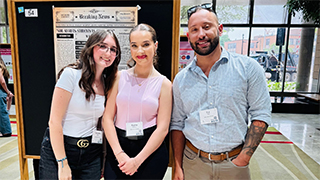
Professor C.J. Urso and students
During the fall 2024 semester, Seton Hall University hosted its third annual Antibiotic
Discovery Symposium, showcasing the work of nursing (B.S.N.) students engaged in original
research on antibiotic-producing microbes. The goal of the project is to search for
new sources of antibiotics at a time when many existing drugs are losing their effectiveness
against resistant bacteria. By studying microbes found in local soil, students are
contributing to the worldwide effort to discover novel compounds that could one day
inform the development of new treatments.
Among the participating teams, nursing majors Hailey Murphy, Bianca Grund, Sophia
Weathers and Samantha Schatz were recognized for the strength of their project. The
team isolated a strain of Bacillus toyonensis that was able to inhibit the growth
of several different kinds of bacteria. Their isolate showed activity against safe
laboratory strains related to the “ESKAPE” pathogens, a group of microbes known for
causing difficult-to-treat infections in hospitals. While preliminary, these results
point toward the possibility of uncovering new antibiotic compounds from common environmental
sources.
This past June, Weathers and Schatz traveled to the University of Wisconsin–Madison
to share their team’s findings at the Tiny Earth Summer Symposium, which brought together
nearly 50 student research groups from across the United States and abroad.
The team’s project originated at Seton Hall in BIOL 2141 Introduction to Microbiology,
a required course for nursing majors that incorporates course-based research. Rather
than following a standard laboratory manual, students in this course design and conduct
their own experiments aimed at discovering new antibiotics in local soil samples.
Their work contributes to a global effort to address antibiotic resistance.
Faculty mentor and visiting assistant professor C.J. Urso, Ph.D., explained that the course is structured to give students the opportunity to practice
authentic science from the beginning of their studies: “Our students leave knowing
they have contributed to real-world science. They’re not just learning about antibiotic
resistance — they’re helping address it.”
As part of Introduction to Microbiology, students isolate microorganisms from the
environment, test them for antibiotic activity, and analyze their results using a
combination of microbiological and biochemical methods. They also employ molecular
techniques such as 16S rRNA gene sequencing to identify antibiotic-producing organisms
and create follow-up experiments to better characterize the activity of the compounds
they detect.
For Murphy, Grund, Weathers and Schatz, the recognition at Seton Hall and the chance
to present their research at the Tiny Earth Summer Symposium highlight the value of
providing early research opportunities in the nursing curriculum. Through this approach,
students gain practical experience with laboratory techniques while also engaging
with one of today’s most urgent public health challenges.
The success of Seton Hall University’s third annual Antibiotic Discovery Symposium
reflects the excellence of the Department of Biological Sciences, particularly its
investment in teaching through meaningful experiential learning. It invests enormous
energy in mentoring students in its labs, training them on cutting-edge instrumentation,
and setting them up to be transformational scientists and healthcare providers.
The College of Arts and Sciences at Seton Hall affords students many opportunities
to participate in original research, including 20 competitive STEM Connect Undergraduate
Research Awards per year. By supporting initiatives like these, Seton Hall affirms
its mission of addressing global health challenges while preparing the next generation
of scientists to lead with curiosity, collaboration and purpose.
Categories:
Health and Medicine
link